How Wars End by Taylor A J P
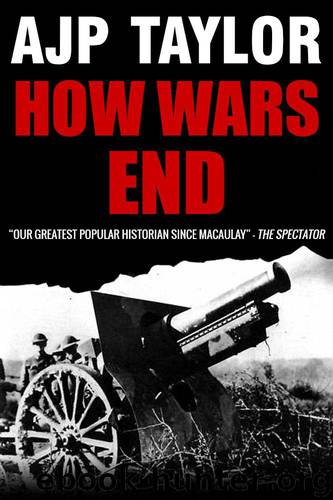
Author:Taylor, A J P [Taylor, A J P]
Language: eng
Format: azw3
Publisher: Endeavour Press
Published: 2014-04-24T16:00:00+00:00
V - The Second World War
The First World War ended with peace, and apart from the Treaty of Brest Litovsk the fighting all came to an end in November 1918.
The Second World War was much more ragged. It began to end as early as June 1940 and it went on, in Japan, until September 1945. In June 1940 France went out of the war and made an armistice with Germany. From 1940 to 1944, official France at any rate was not at war. It is true that parts of France were occupied by the Germans but an unassuming, non-political Frenchman could have passed the years 1940 to 1944 without noticing that there was a war on at all. It was only with the return of De Gaulle and the victory of the allies that France was drawn into the war for the last peace. But there was an actual ending of the war, too, for what was after all a very considerable country. More significant, or more preparatory shall I say, to the ending of the war was the way in which Italy, after some difficulty, drew out of the war in 1943. In July of 1943 Mussolini was overthrown when the official state council turned against him. He was at first interned and later withdrew into northern Italy to set up the Italian Socialist Republic which did not amount to very much. There was however a new government in Italy officially appointed by the King under Marshal Badoglio and from the beginning, that is to say the end of July 1943, it began to put out feelers for a peace arrangement or armistice or short-lived peace treaty. Negotiations went on until October. Earlier in the year, in January, when President Roosevelt met Churchill in Morocco, he had brought into being a new concept, that of unconditional surrender. Roosevelt said, ‘We don’t want a lot of negotiations, we don’t want armistice terms and so on, what we demand from the axis powers is unconditional surrender and we’ll accept nothing less.’
The first time that this was discussed with the Italians, it went on for some six weeks, mainly with the British High Command in North Africa. The British High Command simply could not stomach the idea that there should be unconditional surrender and that the allied commanders should be in supreme control of Italy. They negotiated the terms of unconditional surrender so that one can say that, in a sense, Italy made a conditional surrender. It was only when the Italians had accepted the short-term conditions of this very long negotiation that they eventually accepted the longer-term conditions in the course of the autumn. But, there were terms of a sort and, most importantly, Italy — official Italy that is — withdrew from the war and the Italian government put itself under the control of the supreme allied command — at that time headed by a British general.
This was less successful than the British and Americans had hoped for. They believed
Download
This site does not store any files on its server. We only index and link to content provided by other sites. Please contact the content providers to delete copyright contents if any and email us, we'll remove relevant links or contents immediately.
Whiskies Galore by Ian Buxton(42028)
Introduction to Aircraft Design (Cambridge Aerospace Series) by John P. Fielding(33136)
Small Unmanned Fixed-wing Aircraft Design by Andrew J. Keane Andras Sobester James P. Scanlan & András Sóbester & James P. Scanlan(32808)
Aircraft Design of WWII: A Sketchbook by Lockheed Aircraft Corporation(32299)
Craft Beer for the Homebrewer by Michael Agnew(18251)
Turbulence by E. J. Noyes(8062)
The Complete Stick Figure Physics Tutorials by Allen Sarah(7382)
The Institute by Stephen King(7055)
The Thirst by Nesbo Jo(6957)
Kaplan MCAT General Chemistry Review by Kaplan(6942)
Bad Blood by John Carreyrou(6629)
Modelling of Convective Heat and Mass Transfer in Rotating Flows by Igor V. Shevchuk(6458)
Learning SQL by Alan Beaulieu(6299)
Weapons of Math Destruction by Cathy O'Neil(6292)
Man-made Catastrophes and Risk Information Concealment by Dmitry Chernov & Didier Sornette(6049)
Permanent Record by Edward Snowden(5853)
Digital Minimalism by Cal Newport;(5774)
Life 3.0: Being Human in the Age of Artificial Intelligence by Tegmark Max(5564)
iGen by Jean M. Twenge(5424)
